
When a child is not speaking as expected, parents often receive conflicting advice. One person may recommend waiting, while another suggests immediate therapy. A professional Speech and Language Assessment in Coimbatore can replace guesswork with a clearer picture of the child's communication abilities.
An assessment is not simply a test of how many words a child can say. Communication includes understanding, expression, speech production, social interaction and several related skills.
Why Is an Assessment Recommended?
An evaluation may be useful when a child
- Uses fewer words than expected
- Has difficulty combining words
- Struggles to follow spoken instructions
- Is difficult to understand
- Has trouble answering questions
- Uses limited language during interaction
- Has persistent speech-sound errors
- Shows communication difficulties affecting school or social participation
Assessments can also be relevant for adults experiencing changes in speech or language.
What Information Is Collected First?
A clinician generally begins by understanding the person's history.
For children, parents may be asked about pregnancy and birth history, developmental milestones, medical information, hearing, languages spoken at home, school observations and the nature of the communication concern.
Parents should answer as accurately as possible. There is no benefit in trying to make a child's abilities appear stronger or weaker than they are.
Bringing previous hearing reports, developmental assessments or relevant medical information may also provide useful context.
Receptive Language
Receptive language refers broadly to understanding.
Depending on age, the clinician may examine whether the child understands names of familiar objects, actions, concepts, questions, directions and increasingly complex sentences.
A child can sometimes appear to understand because they follow routines or visual cues. Structured assessment helps determine how much spoken language they understand independently.
Expressive Language
Expressive language involves communicating thoughts and needs.
Assessment may consider vocabulary, sentence length, grammar, ability to answer questions, storytelling and how effectively the child communicates ideas.
Importantly, understanding and expression do not always develop at the same level.
Speech Production
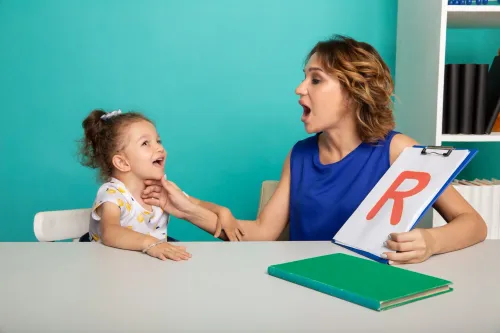
The clinician may listen for substitutions, omissions or distortions of speech sounds and examine how understandable the child's speech is in different situations.
Oral structures and movements relevant to speech may also be observed when appropriate.
Social Communication and Interaction
Communication is more than vocabulary.
Depending on the concern, assessment may look at how a child initiates interaction, responds to others, takes conversational turns, uses language socially and communicates during play or everyday activities.
Does Every Assessment Lead to Therapy?
No.
An evaluation may indicate that development should be monitored, that parents can use specific strategies at home, that further investigation is appropriate or that speech-language therapy would be beneficial.
This is why assessment should come before a predetermined treatment plan.
For families in Coimbatore, Sky Speech Therapy can evaluate speech and language concerns within the broader context of communication and hearing when relevant. This can be particularly useful when parents are unsure whether difficulties relate primarily to speech production, language development, listening or a combination of factors.
A good assessment should leave families with more than a score. Parents should understand what their child currently does well, where difficulties are occurring and what practical next steps may be appropriate.
Keywords